

How contact centers can protect human service levels while supporting legitimate agentic AI automation
Bot-to-bot (B2B) communication is entering a new era.
Even with the development of APIs and self-service portals, companies are increasingly deploying agentic AI to call other businesses directly, automating information exchange in a way that was once only possible between humans. These agentic AI ‘bots’ have the best intentions, but they can wreck havoc on an operation that was built for human interactions.
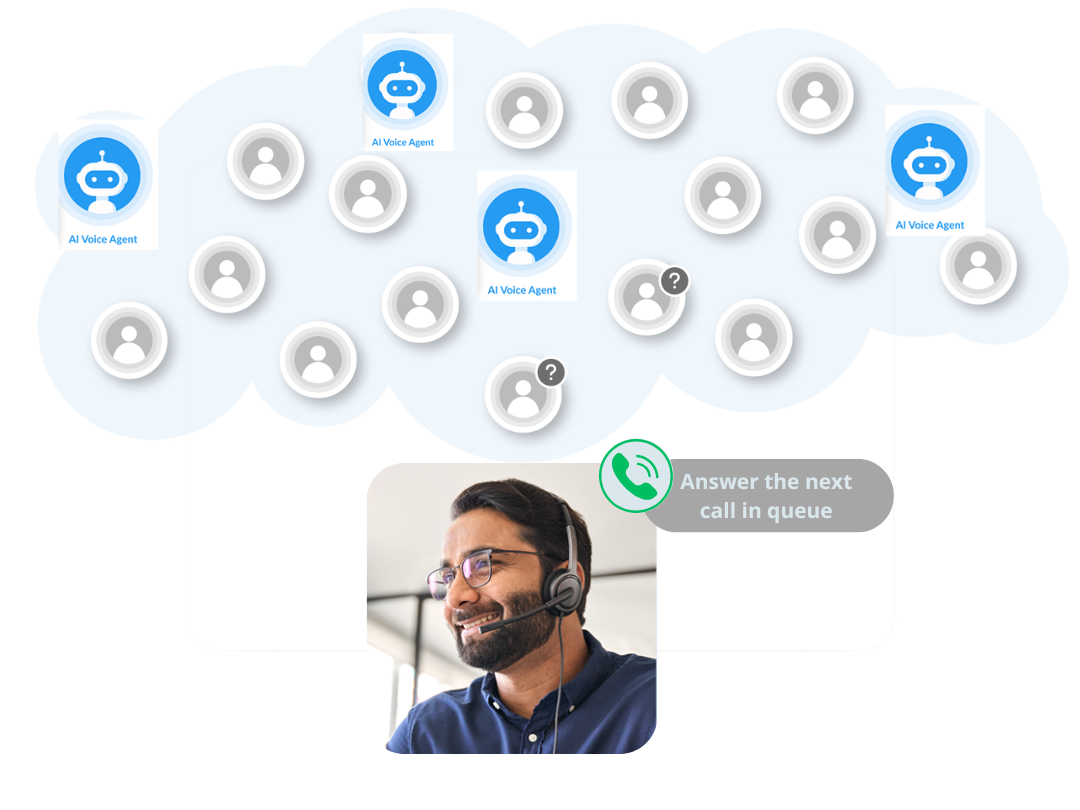
Find the B2B Bot
With McKinsey estimating that agentic commerce will account for nearly $1 trillion worth of orchestrated revenue and at the same time, cost savings could range from 30 to 50 percent; it’s no surprise that companies must now account for how they classify (and handle) agentic-driven communications.
A narrow but important pattern is emerging across industries. One business deploys an AI voicebot to call another business’s inbound contact center to retrieve operational information. These calls are not sales calls, reminders, or collections. These calls aren’t malicious at all. In fact, they’re routine business inquiries such as checking claim status, confirming shipment appointments, or verifying eligibility information: “B2B bots”.
For contact centers that were designed around human callers, this shift introduces new operational challenges. The calls are legitimate and often necessary. But when large numbers of automated callers enter queues designed for people, the strain becomes visible in the service levels, agent experience, call center efficiency, and even CSAT metrics such as NPS and others.
Not to mention... why should a human compete with an AI voicebot for attention?
This is where a new capability is needed. Contact centers must be able to detect, classify, and route bot-originated calls intelligently so that legitimate automation can continue while human service levels remain protected.
What’s Changing: A Rise in Automated Callers
Businesses are increasingly automating operational status checks that historically require human phone calls.
Many industries still rely on voice channels because:
- Some information systems do not offer APIs or structured digital access
- Regulatory workflows still depend on voice verification steps
- External partners operate on legacy systems that only expose information through contact centers
As a result, automation teams are deploying voicebots that can interact with IVR systems and agents to retrieve information.
Common examples include:
- Healthcare: eligibility checks, benefits verification, prior authorization status, and claims status
- Logistics and transportation: shipment status, pickup appointments, and delivery confirmations
- Insurance: policy verification and claim status inquiries
- Retirement services: recordkeeper account status and plan administration inquiries
- Utilities: business account status or service confirmations
- Business banking: operational service availability or account support inquiries
In each case, a system at Company A calls Company B’s contact center to retrieve operational information needed to continue a workflow.
These calls are legitimate. They help businesses move faster and reduce manual effort.
But from the perspective of the inbound contact center, the caller is no longer always human.
What Call Centers Need Now: Smarter Call Routing
The goal is not to block legitimate automation. These calls support real business workflows.
Instead, contact centers need the ability to recognize bot-originated calls and manage them intelligently.
VoxEQ Persona enables this by detecting, classifying, and routing automated callers so that inbound operations can adapt to the new mix of human and machine traffic.
A simple scenario
Consider a hospital systems’ revenue cycle team that is charged with verifying eligibility of health plan members as well as following up on the status of multiple claims that have been submitted. The hospital system has outsourced this function to a company that specializes in healthcare revenue cycle management - a BPO.
A hospital system (or the BPO) deploys an AI voicebot that calls a payor’s provider services line to check eligibility and benefits status. The bot navigates the payor’s IVR, enters the required provider identifiers, and requests confirmation of coverage for a specific service.
Eventually the call reaches a human agent at the payor’s contact center.
The agent proceeds through the standard workflow. They authenticate the caller, confirm provider details, and provide eligibility information.
The request is legitimate. No funds move, and sensitive data may be masked.
Even though the automated bot follows a rigid script and responds with machine precision, the agent still must spend several minutes completing the full workflow. They still spend time on soft skills and human communication. It’s estimated that bot calls last 300% longer than human calls for the simple reason that the bot doesn’t always understand the human workflow. Multiply across thousands of automated calls each day, and agents end up spending hours talking to bots while real people wait in the queue.
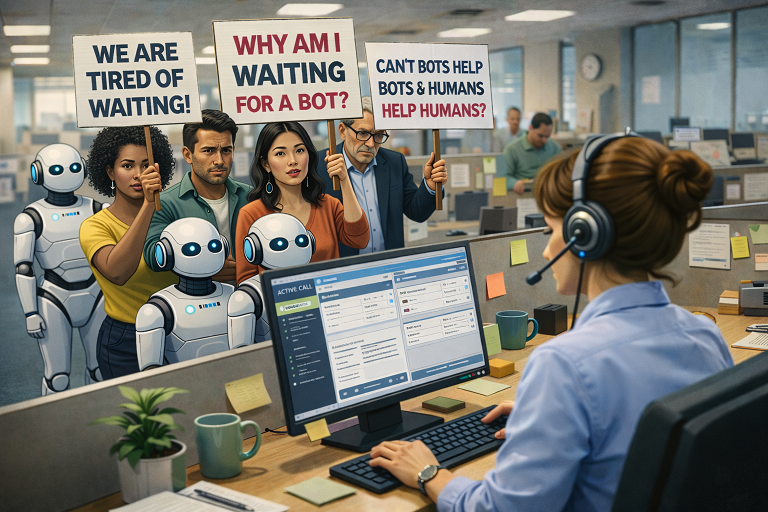
The Challenge: How Bots Clog the Queue and Create Operational Drag
Inbound contact centers are designed for human conversations. Bot-originated calls introduce a different dynamic.
Several operational issues emerge.
Queue congestion during peak periods
Bots are persistent callers.
Unlike humans, automated systems can call repeatedly and at high volume. When several automation systems dial in at the same time, bot traffic can consume inbound queue capacity. This can be exacerbated during high volume intervals...
This creates tension between two legitimate needs:
- Businesses require operational information to complete workflows
- Human callers still expect timely service and reasonable hold times
Without the ability to distinguish bot callers from human callers, contact centers treat both the same. The result is avoidable pressure on service levels.
Repetitive scripted interactions
Agents may find themselves repeating the same scripted sequence with automated callers. The interaction can feel mechanical and less engaging than typical human conversations.
Over time, this contributes to agent fatigue and lower morale, particularly when the volume of bot calls grows.
Higher handle time
Bot callers often follow rigid dialogue patterns. They may repeat questions if they cannot parse a response or require exact phrasing to proceed.
This can lengthen calls due to:
- Repeated authentication steps
- IVR loops triggered by strict input requirements
- Clarification cycles when the bot cannot interpret responses
For the contact center, this increases average handle time without improving customer outcomes.
Should the agent follow the same quality/scripting guidelines for bots as they do for humans? Likely not.
Lower Satisfaction Scores
We’ve also learned that bots are not friendly to NPS/CSAT and other experience related metrics. One operational leader shared: “Some of these bots are actually taking the post call survey and providing dissatisfaction scores at a much higher rate’. What”!?!?
This can impact critical NPS/CSAT metrics that drive reimbursement or avoid painful penalties.
How VoxEQ helps
1. Identify the Bots!
You can’t treat these calls differently UNTIL you identify the Bot call in the first place. This needs to take place upstream, in the IVR, or the initial components of the call flow. Once identified, there are a variety of different ways to treat these calls.
2. Prioritize human callers
When a call center can identify that a caller is an automated system, it gains the ability to protect human service levels.
Human callers can be prioritized for faster pickup and shorter hold times, while legitimate bot callers remain supported through appropriate routing paths.
This helps maintain service quality without rejecting automated workflows.
3. Dynamic queueing during peak load
Traffic spikes are a reality for most contact centers.
When inbound volume increases, VoxEQ enables dynamic queue management so that bot-originated calls can wait longer or move to alternate paths while human SLAs are preserved. This creates a new type of SLA for these types of calls: The Human Service Level (HSLA). Staffing to the HSLA means a reduction in peak staffing requirements, saving 10%-15%.
For example:
- Human callers maintain priority during peak hours
- Bot calls can be queued separately when capacity tightens
- Non-urgent automated requests can be delayed slightly without affecting workflows
This approach stabilizes service levels without disrupting legitimate B2B automation.
4. Smart routing for bot interactions
Not every agent interaction with a bot needs to follow the same path as a human conversation.
VoxEQ enables intelligent routing so bot-originated calls can be directed to the most appropriate destination.
Possible routing options include:
- Agents who are trained and comfortable handling bot-style interactions
- Agents who are new and can use bot calls as a component of ‘nesting’
- Specialized teams that manage operational status inquiries
- Virtual agents designed specifically for bot-to-bot communication - bot to bot!
This improves efficiency and reduces friction for both sides of the call.
5. Optional bot identity assurance
As automated calling increases, contact centers need confidence that incoming bots represent authorized business partners and NOT bad actors.
VoxEQ offers bot identity assurance, a mechanism similar in spirit to voiceprint verification but designed for automated callers.
This capability can provide a trusted signal that:
- The caller is an automated system
- The system belongs to a known organization
- The call is authorized for a specific type of operational inquiry
Identity assurance helps contact centers route calls appropriately without introducing unnecessary friction into legitimate workflows.
Preparing for the Next Phase of Enterprise Automation
The rise of bot-originated B2B phone calls is still early, but the pattern is expanding across industries that rely on operational status checks.
Contact centers do not need to choose between supporting automation and protecting human service levels IF they can identify automation early.
With the right detection, routing, and identity assurance capabilities, inbound operations can accommodate both.
VoxEQ helps enterprises recognize when bots are calling, route those interactions intelligently, and ensure that human callers continue to receive the service they expect.