

Better containment comes from fitting the conversation to the caller, not from pushing them to stay.
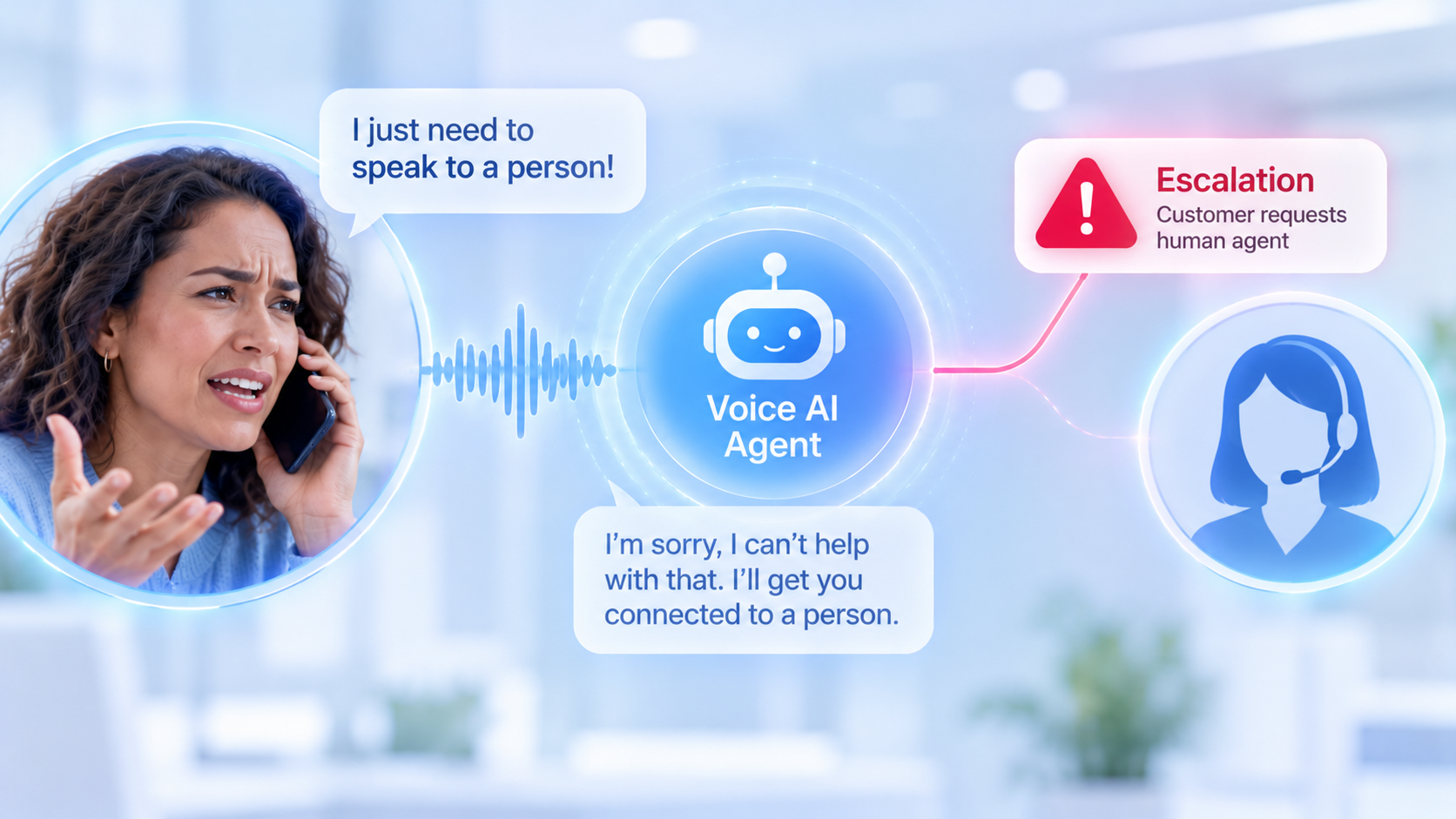
Margaret is 79 and calling her bank about a card that stopped working at the pharmacy. The virtual agent greets her warmly and asks how it can help. She explains. It asks her to rephrase. She tries again, slower this time. It offers a menu of options, and none of them is quite her problem.
On the third try she says the words every voice AI team knows by heart: "Can I just talk to a person?"
She gets one. And the first thing the person asks is what she's calling about.
From the dashboard, nothing went wrong. The AVA recognized an escalation, the transfer completed and the call was resolved. From Margaret's side of the line, she spent four minutes explaining her problem to a machine, then started over.
Two surveys, two different handoffs
Ask the people who run contact centers, and the handoff is in good shape. In Five9's 2026 Business Leaders CX Report, 96% of CX decision-makers said their organization preserves context effectively when AI hands a customer to a human.
Ask the customers, and it looks different. In the same research, 83% of consumers said they have to repeat themselves after being transferred, and 35% said it happens often or always.
That gap doesn't fall evenly across callers. Five9's consumer survey found the repeat-yourself rate climbs to 51% for the Silent Generation. The reason people escalate in the first place follows the same pattern. Asked why they left the AI, 38% of Gen Z said the bot kept misunderstanding them. Among baby boomers it was 59%, and among the Silent Generation, 62%.
So older callers are the most likely to hit a wall with the AVA, and the most likely to start over once they get past it. They get the worst of both halves of the handoff.
The rescue model
Most escalation logic works like a lifeguard. The AVA keeps trying until something tells it the caller is in trouble: a failed intent, a repeated "agent," a second "I didn't catch that." Then it pulls them out.
By that point the call has already gone badly. The caller is frustrated, the clock has been running, and the human who picks up is starting from behind.
Designing the handoff as a rescue means the decision always comes late, and it lands hardest on the callers who hit trouble soonest. The AVA treats every caller the same until one of them proves it shouldn't have.
Decide at the front door
There's another option: give the AVA a sense of who's likely on the line before the first question, not after the third failure.
That's what voice bio-signal analysis does. VoxEQ Persona analyzes a few seconds of natural speech and captures three things: age, birth sex and height. It captures nothing else. It returns that as a signal via API to the AVA and the routing engine already running the call. The caller doesn't enroll, opt in or answer anything extra.
With a likely-senior signal in hand at the start of the call, the AVA doesn't have to wait for things to go wrong. Teams can design for it up front:
Shorten the path for high-stakes calls. For a caller likely to be older, reporting fraud or disputing a charge, the AVA can offer a person right away instead of after three failed turns.
Change the conversation, not just the exit. Slower pacing, one question at a time, explicit confirmations and fewer open-ended prompts. A few small design choices can head off a lot of "I didn't catch that."
Send the transfer to the right person. When the call does go to a human, the routing engine can send it to agents with a strong track record with that caller segment, instead of whoever is free next.
Keep the signal through the transfer. The routing signal goes into the CCaaS platform with the call, so the agent who answers knows what the AVA knew. Margaret's second conversation can pick up where her first one stopped.
A signal, not an assumption
To be clear about what this isn't: it isn't a rule that sends every older caller to a human. Plenty of 75-year-olds will happily check a balance with a virtual agent and hang up satisfied. Plenty of 25-year-olds can't stand bots.
The age signal is one input into journey design, not a verdict on a caller. It lets teams tune the defaults (how early to offer a human, how much to confirm, where to route) for the callers who need them most, while everyone else keeps the fast path. Offering a human sooner is not the same as forcing one.
Better containment, not just more of it
This can sound like a threat to containment, the metric most AVA programs live and die by. Offer humans earlier and containment drops, right?
Not necessarily. A contained call that ends with a frustrated caller ringing back tomorrow isn't a win. It's an escalation that hasn't happened yet. When the AVA knows who it's talking to, the calls it keeps are more likely to stay resolved, and the calls it passes on arrive in better shape. That's the Force Multiplier idea: human context makes the AVA better at the calls it should handle, and better at knowing which calls it shouldn't.
Three numbers to pull this week
If you run a voice AI program, these are worth checking before the next roadmap meeting:
- Repeat rate after transfer, by caller segment. If you can only see the average, you can't see who's paying for it.
- Failed turns before escalation, by segment. How many tries does the AVA take before it lets go, and is that number the same for everyone?
- Repeat contact within seven days of a contained call. This is the containment that doesn't hold.
If your current data can't split these by segment, that's the first gap worth closing. VoxEQ Insights can run the same voice analysis on calls you've already recorded to give you a baseline.
Whose job is the handoff?
Usually it belongs to everyone in theory and no one in practice. The AI team owns the bot, the operations team owns the agents, and the moment between them belongs to nobody.
Callers like Margaret don't see an org chart. They see one company that made them explain themselves twice. The fix starts before the handoff, at the front of the call: know who's likely on the line, and design the call around that from the first second.