

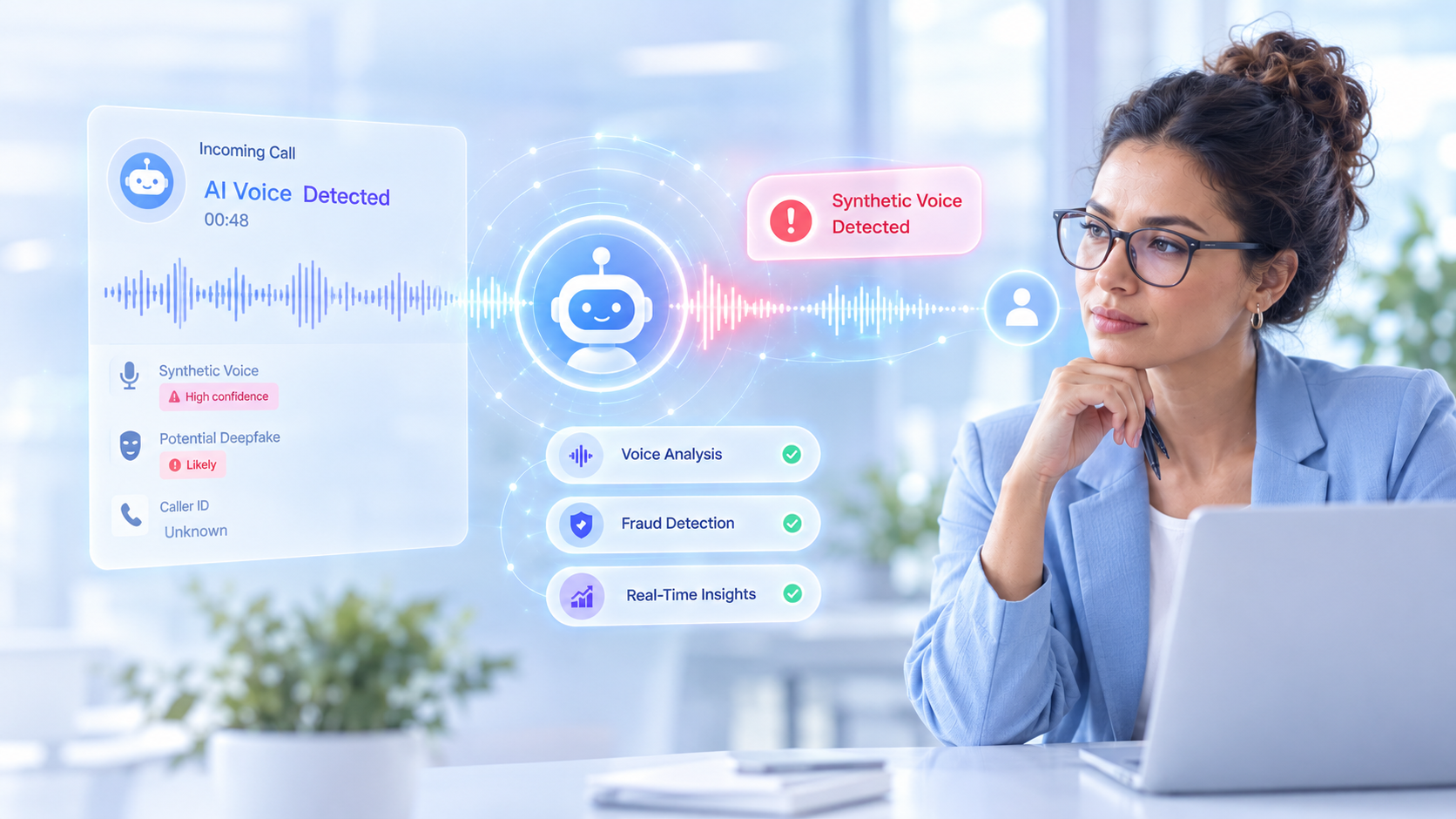
Not everyone calling your contact center is a person. Some callers are bots, sent by partners to check an order or update an account. Others are synthetic callers trying to get into a customer's account. Both sound human enough that your reports count them as customers.
This is already common. In a 2026 Gartner survey, 41% of organizations said synthetic callers had targeted them over the phone (link to download the Gartner report). When we ask telecom providers how many synthetic callers reached them last month, we hear the same answer every time: they know it's happening, but they can't put a number on it.
Below, we cover why that number matters, what synthetic voices are, the types calling you and the risks of leaving them uncounted. Then we show how VoxEQ Insights finds them in the calls you've already recorded, and what else those recordings reveal about fraud and routing.
Why this question matters
Telecom providers sit at the front of the voice channel. They take enormous inbound volume and handle SIM swaps, number ports and account changes over the phone, so any caller who isn't who they claim to be is a direct line to a customer's identity.
That threat is no longer theoretical: in a 2026 Gartner survey, 62% of organizations reported an AI-generated impersonation attempt. Deloitte expects generative AI to push U.S. fraud losses from $12.3 billion in 2023 to $40 billion by 2027.
Yet the number that matters most is the one almost nobody has: what share of your own calls came from a machine. Without it, staffing, handle time, FCR and fraud planning all rest on the assumption that a person is on the other end of every call.
What synthetic voices are
A synthetic voice is speech generated or altered by software rather than spoken live by a person. Some sound robotic. Many now sound human enough to pass by ear.
Not every synthetic caller is a bad actor. The ones reaching your contact center tend to fall into four groups:
- B2B bots and voice AI agents. Software calling on behalf of another business to check order status, confirm an account detail or request a service change. Usually legitimate, often high volume.
- Automated checks and scripts. Systems running repeated status, price or availability lookups. Rarely harmful, but they inflate volume and tie up queues.
- Cloned voices. Speech modeled on a real person, used to impersonate an account holder. This is the synthetic caller most people picture.
- Fully synthetic personas. A made-up voice that doesn't match anyone, used to probe accounts, test knowledge questions or social-engineer an agent.
The first two belong in a different queue. The last two belong on your fraud team's radar. Today, most contact centers can't tell them apart from each other, or from a customer.
The risks of not knowing
When synthetic callers blend into your volume, the damage is quiet. Nothing breaks. The numbers just drift.
- Account takeover. A cloned or synthetic voice on a SIM swap, number port or account-change queue is a direct path to a customer's identity and money.
- Wasted capacity. Every bot call that reaches an agent is a real customer waiting longer, and an agent hour you paid for.
- Skewed reporting. Staffing forecasts, handle-time averages, FCR and campaign response all assume a person called. If some didn't, every plan built on them is off.
- Blind spots that grow. Synthetic traffic that isn't counted can't be trended. By the time it shows up as a fraud loss or a missed SLA, it's been building for months.
- Compliance exposure. Fraud and compliance teams are increasingly expected to show they know what's reaching the voice channel, not just what they stopped.
How VoxEQ Insights answers the question
VoxEQ Insights analyzes the calls your contact center has already recorded. Using voice bio-signal analysis, it flags calls with voice patterns consistent with synthetic or automated callers, and turns that into a picture you can act on:
- Your real human share of call volume, so staffing and reporting run on people, not totals
- Where synthetic traffic clusters, by number, queue, time of day and campaign
- Which kind it looks like, routine B2B automation or synthetic voices showing up on high-risk queues
- Whether it's growing, when you run Insights monthly or quarterly instead of once
Because it works on recordings, there's nothing for callers to enroll in, no change to the live call and no new data to collect. Your team gets the findings as a report, walked through live, with specific recommendations:
- Give known B2B bots and voice AI agents their own path, built for fast, structured requests
- Put real-time screening first on the queues where synthetic voices concentrate
- Rebuild forecasts and KPIs on human volume
The goal isn't to block automation. It's to know which callers are which, and handle each one on purpose.
And by the way...
Once synthetic calls are separated out, the same recordings answer two more questions.
Where is fraud getting in? Insights surfaces caller-profile mismatches: calls where the voice doesn't fit the expected profile of the account holder. One mismatch is easy to miss. A cluster on the number-port queue, after hours, across three months, gives your fraud team a place to start.
Which agents should take which calls? With only human calls left, Insights lines up demographic-based caller segments against outcomes you already track, like CSAT, FCR, AHT and escalation rate. You see which agent-caller pairings consistently perform best, and you can route on that evidence instead of on whoever's free.
One question about synthetic voices turns into three answers: who's really calling, where the risk is, and how to route the people you actually serve.
Get a retrospective on your calls
Synthetic callers aren't going away. The good news: you already have the recordings to find them. VoxEQ Insights turns those calls into a retrospective on who's really calling, and what to do about it.
- Learn what your calls show: your human share of volume, where synthetic callers cluster, which agent-caller pairings perform best and where caller-profile mismatches concentrate
- Answer the questions behind the numbers, like why certain queues draw synthetic traffic or why some agents resolve certain callers faster
- Act on specific recommendations for routing, staffing and fraud controls, walked through live with your team
Run it once for a baseline, or monthly or quarterly to see where things are heading.