

A voice intelligence layer that helps enterprise support recognize the returning caller, not just the returning phone number.
Picture a virtual agent answering the support line for a medical equipment manufacturer.
A caller says an imaging system is throwing errors, and before the agent can do anything useful, it works through its script: "Can you provide your account number?" "What's the site ID?" "Can you confirm the last four digits of your service contract?" "What's the make and model of the unit?" "Have you contacted us about this issue before?"

The caller is a technician standing in a hospital hallway, not logged into a portal, without a contract number memorized. Every question is one more chance for the call to stall. It's a familiar story: technical support has the lowest first-call resolution rate of any industry segment contact centers track.
SQM Group, which benchmarks performance across more than 500 centers, puts it at roughly 64%, against a 71% cross-industry average and 77% in retail. Some of that gap is genuine diagnostic complexity. A meaningful piece of it is everything that happens before diagnosis even starts.
The Identification Gap in Enterprise Support
Genesys defines Automatic Number Identification, the technology behind Caller ID, as data that "identify[s] the phone number of the caller," not the person holding it. That's often enough in consumer support.
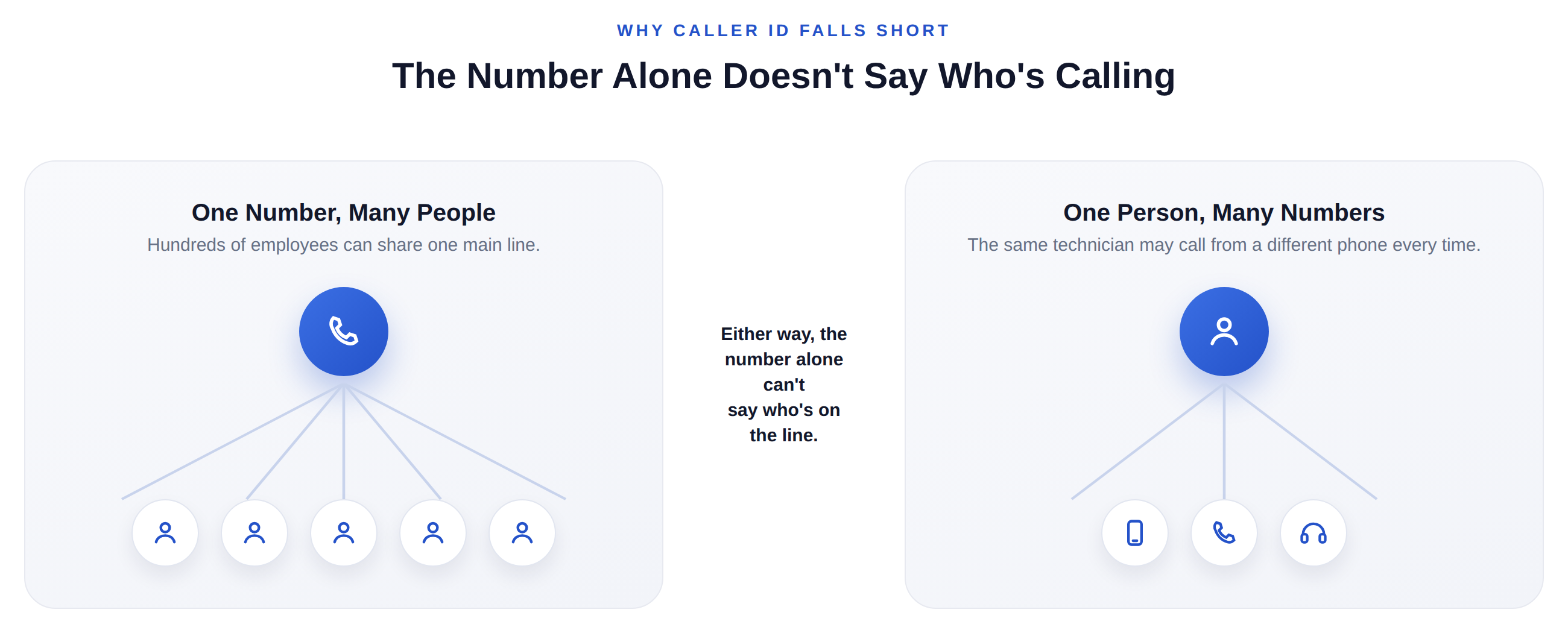
In enterprise B2B support, it rarely is: a hospital, factory, or data center may route hundreds of employees through a handful of shared numbers while operating thousands of assets with their own models, locations, and service histories, and the same technician may call from a different phone every time. Either way, the number alone can't say who's actually on the line or which of that account's assets and history are relevant to them.
The result is valuable time spent establishing context before the actual problem can be addressed, time that matters most when both the person calling and the issue they're calling about are high value.
What Is Caller Context?
Caller context, built on voice intelligence, is an additional layer of insight that sits on top of the systems an enterprise support organization already runs: the IVR, the virtual agent platform, the CRM, the case and asset-management systems behind it. Using voice intelligence, it helps that stack recognize when a caller is probably someone it has spoken with before in that account.
In short, Caller context:
- Sits on top of existing IVR, virtual agent, and CRM systems rather than replacing any of them
- Uses voice intelligence to recognize when a caller is probably a returning individual
- Gives the systems already running the call, human or virtual, one more signal to work with
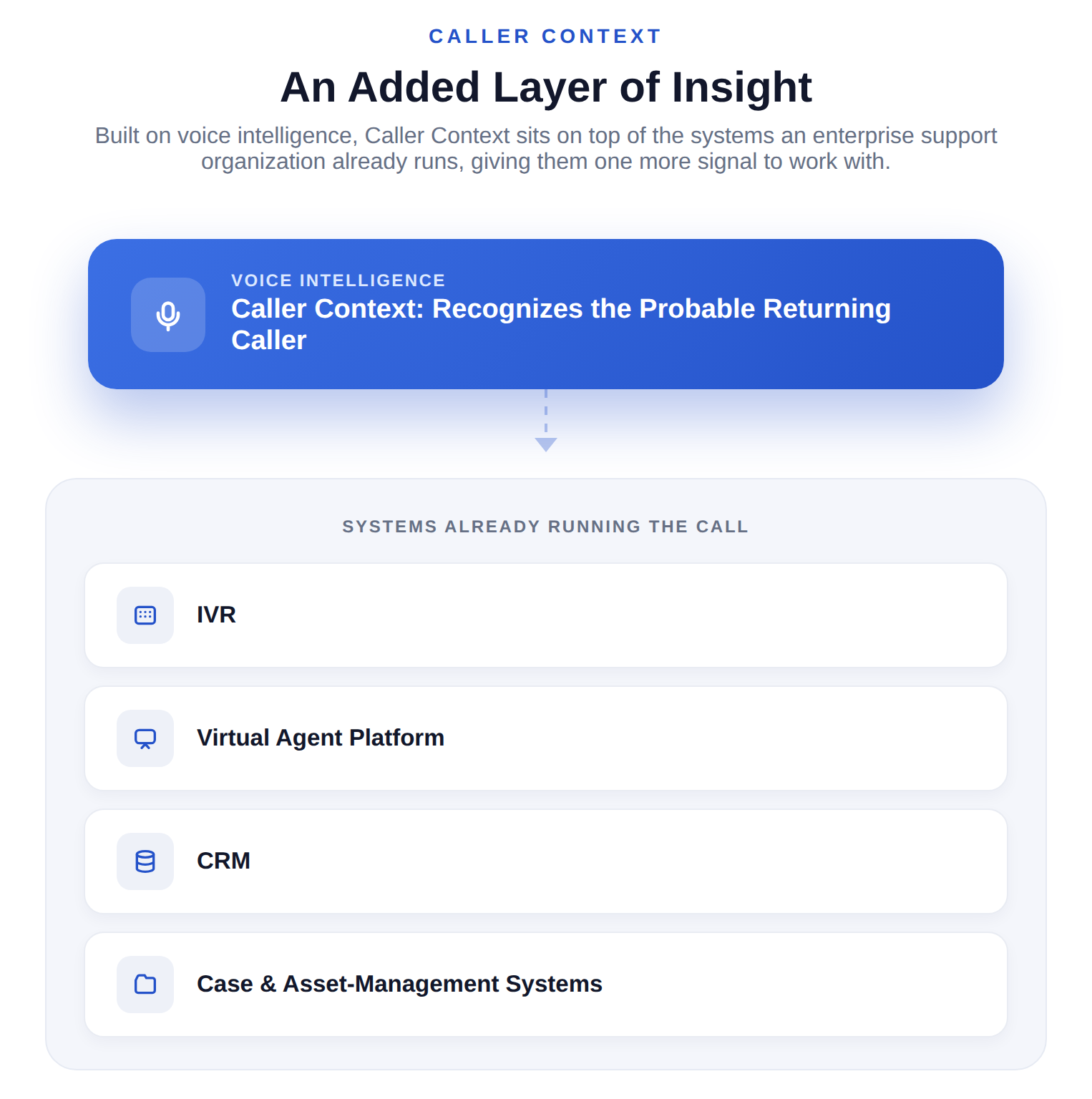
It isn't a new system of record. It's one more signal: not just which number is calling, but who is probably on the line, and what history makes worth asking about first.
Voice Can Help Narrow the Search
Consider that same technician, calling about a medical imaging system. The hospital may operate multiple MRI, CT, X-ray, and other imaging systems. Finding a serial number or asset tag while standing near complex equipment isn't always easy. But the same technician probably works with a relatively small subset of those systems, and has likely called about them before.
Caller context can help the enterprise support platform recognize that relationship and quickly narrow the equipment, previous cases, and service history most likely relevant to the caller. With Caller context, the same call from the opening example might start differently:
"It looks like recent calls from this account on imaging issues have involved two MRI units in the west wing. Are you calling about one of those?"
The technician confirms in one turn, instead of working through a five-question script. Instead of beginning every interaction from scratch, the support experience begins with useful context: the layer of insight doing its job before the real conversation even starts.
Better Conversations for Human and Virtual Agents
That context can benefit both human support representatives and AI-powered virtual service agents, and it isn't locked to one or the other.
Because caller context sits above the underlying systems rather than inside just one of them, the same layer of insight is available wherever the call happens to be.
For virtual agents: the system can confirm the probable equipment and immediately use its service history to guide the conversation, instead of running a long identification script. | For human agents: the same context can arrive the moment a call transfers from a virtual agent, so nothing resets at the handoff. |
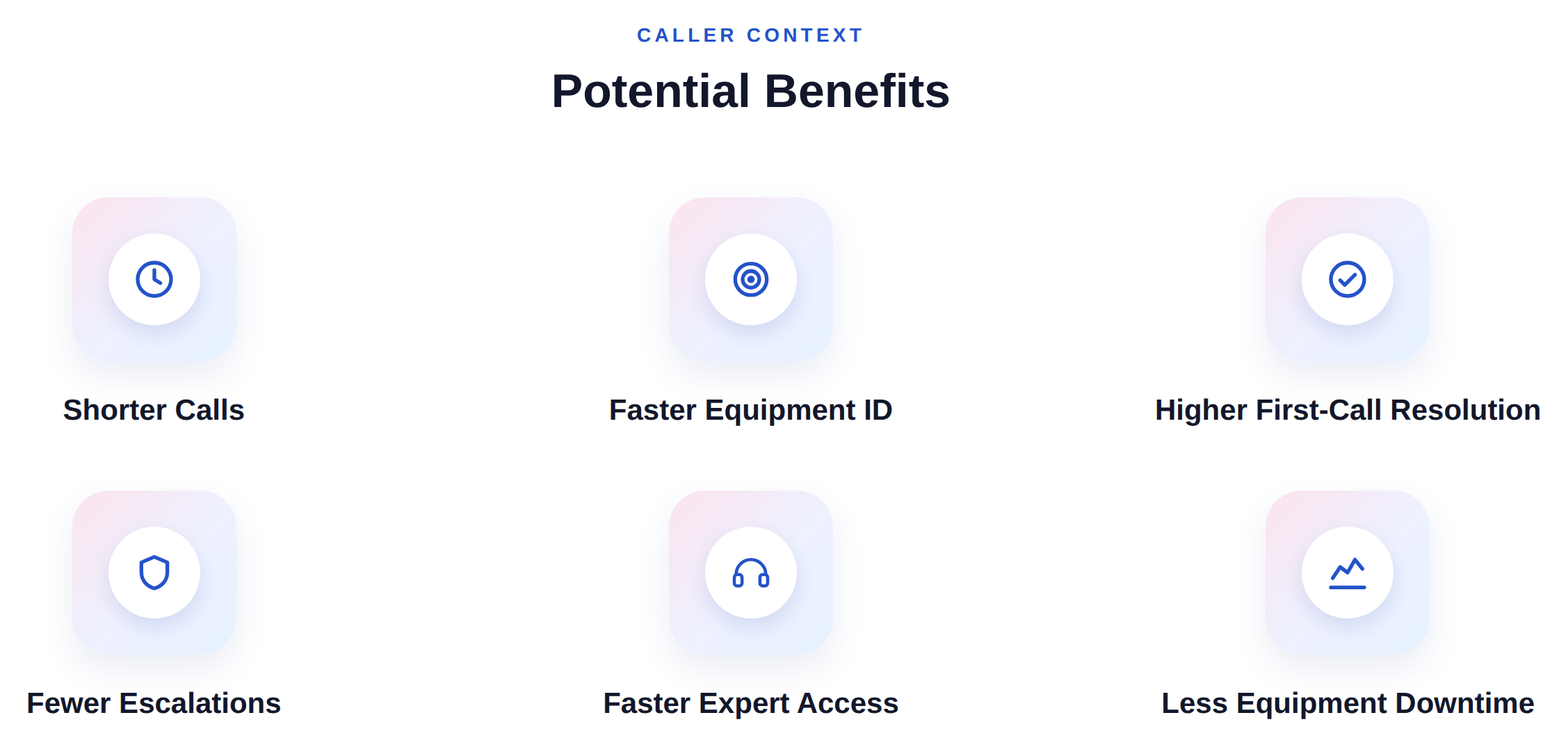
Beyond what's pictured above, the same context also means better use of previous case and service history, and less time taken from highly skilled employees who are calling for support in the first place. That last point is especially important in enterprise B2B service.
For consumer contact centers, saving a minute may primarily reduce agent labor costs. In technical support for medical equipment, industrial systems, telecommunications infrastructure, laboratory equipment, or other high-value assets, both sides of the call can be expensive.
The equipment is valuable, but so is the time of the engineer, technician, clinician, or other specialist calling about it. Resolving the issue correctly on the first call can therefore create value far beyond traditional contact-center efficiency.
A More Contextual B2B Support Experience
Voice intelligence creates an opportunity to make enterprise support more contextual from the first seconds of an interaction.
Instead of treating every incoming call as a new and disconnected event, support systems can use the caller's voice as another layer of insight to help determine what is most likely relevant, without replacing the platforms, records, or workflows already doing the rest of the job.
For organizations supporting complex, high-value equipment, that can mean getting to the right problem, the right history, and ultimately the right solution faster.